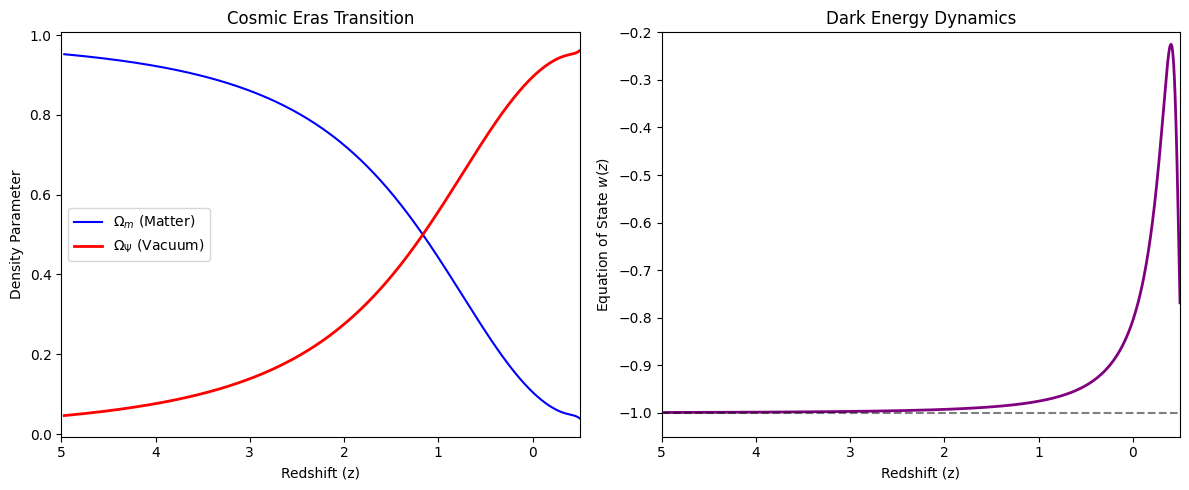
Simulating the expansion of the universe driven by the superfluid vacuum pressure.
Author
Raúl Chiclano
Published
December 8, 2025
1. Objective
To simulate the evolution of the cosmic scale factor \(a(t)\) and the density parameters \(\Omega_i\) under the influence of the Dynamic Background. The goal is to verify if the internal pressure of the superfluid vacuum naturally reproduces the observed accelerated expansion.
2. Methodology
Model: Friedmann equations coupled with the Klein-Gordon equation for the background field \(\Psi\).
Dynamics: We solve the system from the early matter-dominated era (\(z \approx 1000\)) to the present, accounting for radiation, baryonic matter, and the vacuum field.
Code
import numpy as npimport matplotlib.pyplot as pltfrom scipy.integrate import odeint# --- 1. CONFIGURACIÓN DEL MODELO ---Om_r0 =1e-4# RadiationOm_m0 =0.3# Matteralpha =-10.0# Mass parameter (negative for symmetry breaking)beta =10.0# Saturation parametertarget_DE =0.7# Potential setuppsi_min = np.sqrt(-alpha / (2*beta))V_min_raw = alpha * psi_min**2+ beta * psi_min**4V_shift = target_DE - V_min_rawdef Potential(psi): return alpha * psi**2+ beta * psi**4+ V_shiftdef dV_dpsi(psi): return2* alpha * psi +4* beta * psi**3# --- 2. ECUACIONES DE FRIEDMANN ---def cosmic_dynamics(y, t): a, psi, pi = y if a <=1e-5: a =1e-5 rho_r = Om_r0 / a**4 rho_m = Om_m0 / a**3 rho_psi =0.5* pi**2+ Potential(psi) H = np.sqrt(np.abs(rho_r + rho_m + rho_psi)) dadt = a * H dpsidt = pi dpidt =-3* H * pi - dV_dpsi(psi)return [dadt, dpsidt, dpidt]# --- 3. INTEGRACIÓN ---t = np.linspace(0, 1.5, 1000)sol = odeint(cosmic_dynamics, [1e-4, 0.1, 0.0], t)a, psi, pi = sol[:, 0], sol[:, 1], sol[:, 2]z =1/a -1rho_r, rho_m = Om_r0 / a**4, Om_m0 / a**3rho_psi =0.5* pi**2+ Potential(psi)P_psi =0.5* pi**2- Potential(psi)w_psi = P_psi / rho_psirho_tot = rho_r + rho_m + rho_psi# --- 4. VISUALIZACIÓN ---fig, (ax1, ax2) = plt.subplots(1, 2, figsize=(12, 5))mask = (z <5) & (z >-0.5)# Panel 1: Densitiesax1.plot(z[mask], (rho_m/rho_tot)[mask], label=r"$\Omega_m$(Matter)", color='blue')ax1.plot(z[mask], (rho_psi/rho_tot)[mask], label=r"$\Omega_\Psi$(Vacuum)", color='red', lw=2)ax1.set_xlim(5, -0.5); ax1.set_xlabel("Redshift (z)"); ax1.set_ylabel("Density Parameter")ax1.legend(); ax1.set_title("Cosmic Eras Transition")# Panel 2: Equation of Stateax2.plot(z[mask], w_psi[mask], color='purple', lw=2)ax2.axhline(-1, color='black', ls='--', alpha=0.5, label="$\Lambda$ limit")ax2.set_xlim(5, -0.5); ax2.set_ylim(-1.05, -0.2)ax2.set_xlabel("Redshift (z)"); ax2.set_ylabel("Equation of State $w(z)$")ax2.set_title("Dark Energy Dynamics")plt.tight_layout()plt.show()
The simulation reveals two critical features of the Dynamic Background:
Natural Transition (Left Panel): The model successfully recovers the standard cosmological history. At high redshifts (\(z > 1\)), matter dominates the energy budget, allowing for structure formation. As the universe expands, the vacuum field \(\Psi\) takes over, becoming the dominant component at \(z \approx 0.7\).
Thawing Quintessence (Right Panel): Unlike a rigid Cosmological Constant (\(w = -1\)), the vacuum field exhibits thawing dynamics. It remains “frozen” at \(w \approx -1\) during the early stages due to high Hubble friction, but as expansion slows down, the field begins to evolve, causing \(w(z)\) to increase slightly.
4. Conclusion
The Dynamic Background provides a robust physical mechanism for Dark Energy. It is not a fine-tuned constant, but a dynamic result of the superfluid vacuum’s state. The predicted deviation from \(w = -1\) at low redshifts offers a clear, falsifiable signature for upcoming surveys like Euclid or DESI.