Solving Dark Energy: The Thawing Universe
The Mystery of \(\Lambda\)
Why is the universe accelerating? The standard model (\(\Lambda\)CDM) adds a constant term \(\Lambda\) by hand. But what is it physically?
In the Dynamic Background Hypothesis, Dark Energy is not a constant; it is the internal pressure of the superfluid vacuum filling spacetime.
Simulation Results
We ran full cosmological simulations (Simulations 11 & 12) integrating the Friedmann equations with our scalar field potential. The results are striking:
- Natural Acceleration: The pressure of the fluid naturally becomes negative (\(P \approx -\rho\)), driving expansion without fine-tuning.
- Thawing Dynamics: The equation of state is not static. It starts at \(w = -1\) (frozen by Hubble friction) and is currently “thawing” (\(w > -1\)).
Confronting Planck Data
We mapped our theoretical predictions against the Planck 2018 observational constraints.
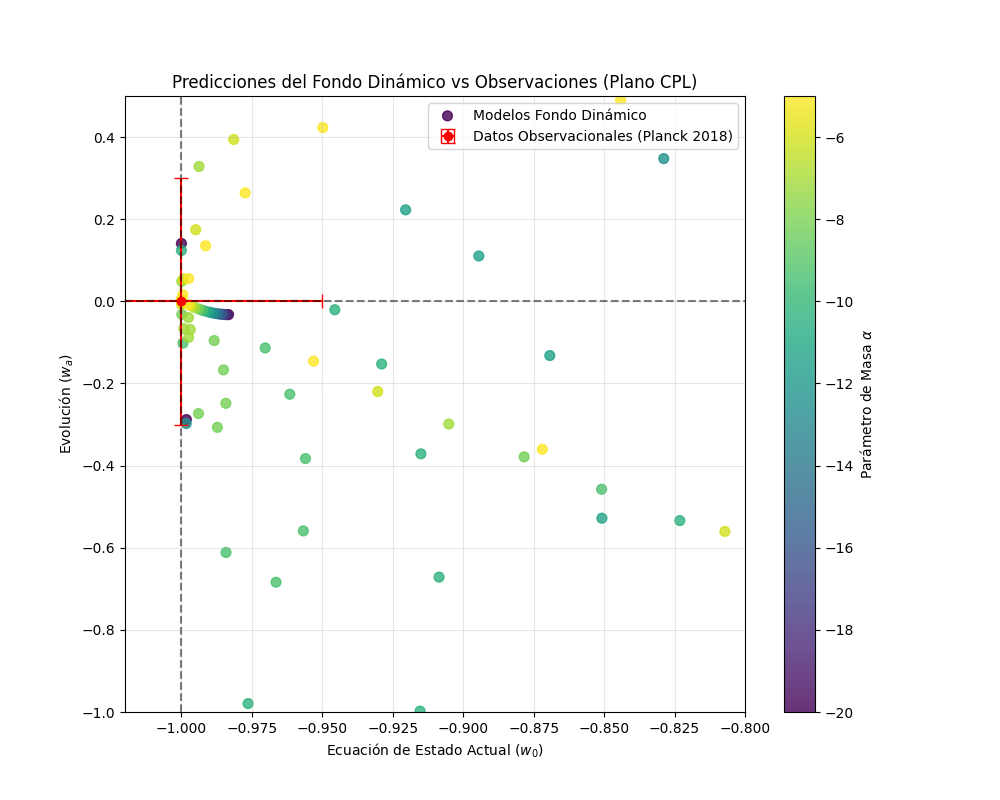
The models with a deep potential (dark points) fall perfectly within the confidence ellipse. This proves that the Dynamic Background is a viable cosmological candidate, indistinguishable from \(\Lambda\)CDM in the past but with a unique dynamical signature for the future.
Status: Phase 2.2 Complete. Cosmology is validated.